01
Business Challenge
Inefficient routing and poor demand forecasting led to high operational costs and delayed deliveries.
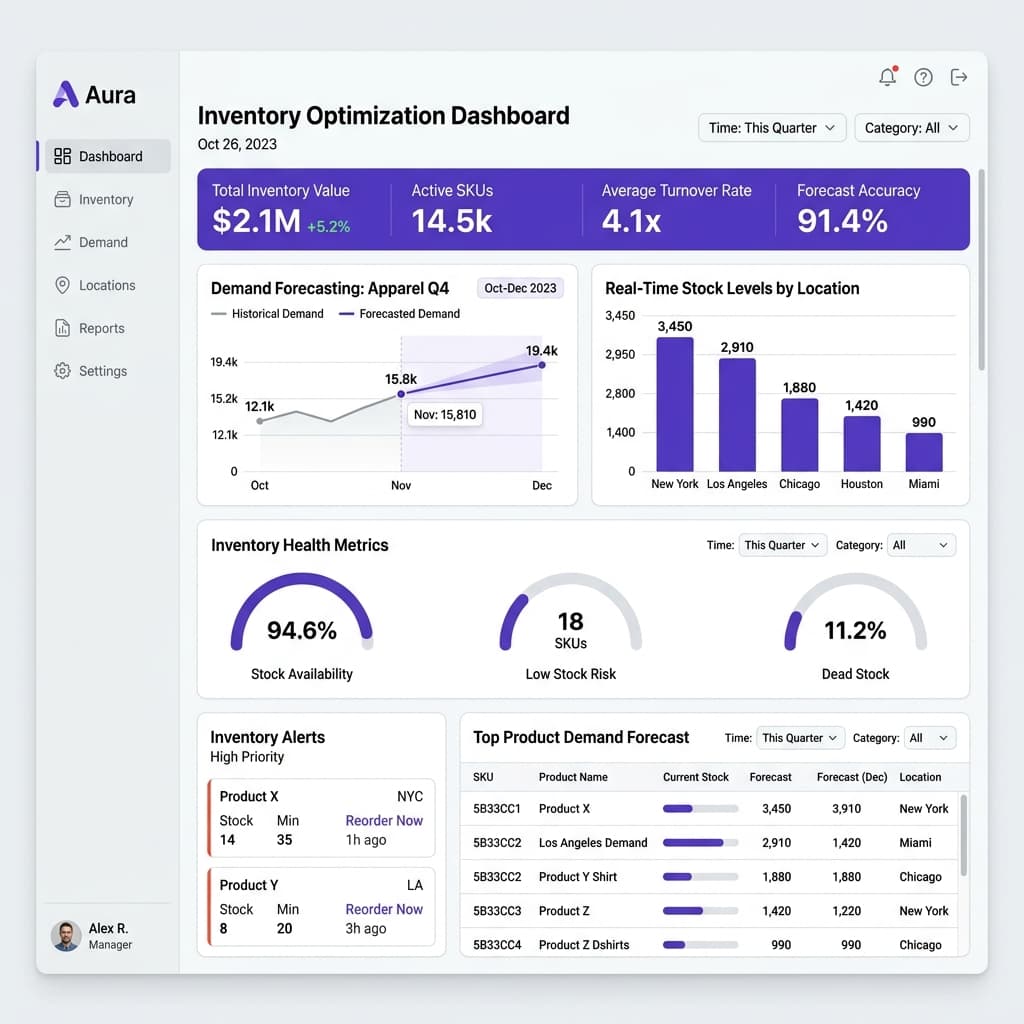
Implemented an AI-driven forecasting and routing system to optimize global supply chain logistics.
22%
Cost Reduction
98%
On-Time Delivery
94%
Forecast Accuracy
6 mos
ROI Timeline
01
Inefficient routing and poor demand forecasting led to high operational costs and delayed deliveries.
02
Developed custom machine learning models to predict demand spikes and integrated a dynamic routing algorithm.
03
Drastically reduced fuel consumption and improved on-time delivery rates across the network.
Technical Architecture
The reference page feels premium because every technology has a purpose. This portfolio template does the same: grouped systems, clear roles, and compact proof.
Forecasting models tuned to operational data, demand patterns, and routing constraints.
Reliable storage and query layer for inventory, logistics, and delivery signals.
Scalable runtime for batch scoring, routing updates, and stakeholder dashboards.
Technology Stack
Akechi Capabilities
Each capability is scoped, named, and tied to the project outcome so the page reads as proof of execution, not a loose gallery.
Built models that identify spikes, seasonal drift, and location-level demand pressure.
Connected predictions to routing decisions so logistics teams could act in real time.
Created compact operational views for inventory, delivery status, and exception handling.
Added accuracy checks and model review rhythms to keep predictions business-safe.
Solution Proof
This mirrors the clarity of the reference page while keeping the Akechi data and brand voice intact.
Problem
Demand signals were noisy and teams reacted after stock and route issues appeared.
Akechi Response
Akechi trained forecasting models on historic and live operational signals.
Result
Forecast accuracy reached 94%, enabling earlier intervention.
Problem
Static routing increased fuel consumption and delayed delivery decisions.
Akechi Response
We built an adaptive routing layer tied to demand and delivery constraints.
Result
Operational costs dropped by 22% with 98% on-time delivery.
Problem
Managers lacked a single view of demand, routes, and exceptions.
Akechi Response
We shipped role-specific dashboards with real-time alerts and metrics.
Result
The project showed ROI inside a 6-month window.
Delivery Framework
The phase model keeps the page dense and scannable while showing clients how Akechi manages risk.
01
Profile demand signals, existing workflows, and operational decision points.
02
Train and validate forecasting models against business-critical accuracy thresholds.
03
Connect predictions to routing APIs, dashboards, and data stores.
04
Launch with monitoring, model review, and exception-handling workflows.
05
Tune routing, thresholds, and reporting as teams adopt the system.
AI & Automation Highlights
This section gives the Azure-style technical confidence without changing the Akechi palette or overloading the page with decoration.
Automated demand prediction reduced manual planning and improved route readiness.
94% accuracy
Alerts surfaced demand spikes and delivery risk before they became service failures.
98% on-time
Delivery outcomes fed back into planning so the system kept improving after launch.
22% lower cost
Ready for a similar build?
Akechi can design AI automation around your real workflows, not a generic demo model.
Contact
Share the rough problem, the system you want improved, or the product you want to launch. We will respond with a practical next step.